A set of introductory articles written or compiled by libcom.org clearly explaining key issues and topics from a libertarian communist perspective.
libcom introductory guide

Oakland general strike, 2011.
libcom.org: an introduction
libcom.org is a resource for all people who wish to fight to improve their lives, their communities and their working conditions. We want to discuss, learn from successes and failures of the past and develop strategies to increase the power we, as ordinary people, have over our own lives.
This article in: Deutsch | Español | Français | Italiano | Kurdi | کوردی | Polski | Português | Svenska | 中文 | Nederlands

The problem
We wake up every day to go to work, taking orders from a manager. We sit at work counting down the minutes until we go home, counting down the days until the weekend, counting down the weeks until our next holiday, wishing our lives away. Or worse, we can't find a job, so we have to scrape by on benefits. We worry about paying the bills and making rent and we always seem to have the same bank balance at the end of every month. We wonder if we'll be able to put anything by to one day start a family, and think maybe next year. We get angry about the latest war the government's decided to start, and they're ignoring us again. We watch the latest news on climate change and wonder if our children have a future.
The problem is that every day we recreate a world that wasn't built to serve our needs and is not under our control. We are not human beings, we are human resources, cogs in a machine that knows only one purpose: profit. The endless pursuit of profit keeps us stuck in boring jobs, or looking for them when we're out of work. It keeps us worrying about the rent or mortgage payments every month when our homes were long since built and paid for. It keeps the planet on course for an environmental disaster as climate change accelerates and world leaders pontificate.
 In this world, everything has its price. Every day, more and more things enter the market. A century ago it was automobiles, today even DNA and the Earth's atmosphere have a price. For those things which we enjoy most in life - friendship, love, play - the idea of giving them a price is absurd or even obscene. The idea strikes us as absurd because the market does not work by the same principles we do. 'Market forces' leave hundreds of millions starving in a world with surplus food. Millions die of preventable diseases while pharmaceutical companies spend more on marketing than basic research. The market does not recognise human needs unless they are backed up with cash. The only way to get the cash is to work for a boss or claim benefits. By working for a wage, our own bodies and minds enter the market as things to be bought and sold.
When we work, we create more things which can be sold on the market. But we don't get paid the full value of what we create, otherwise there would be nothing left over as profit for the bosses. If the company can't make big enough profits, it will shut down, we will be made redundant and the money will be invested elsewhere. The bosses' interests are not the same as ours. The problem with the market is not that prices are too high or supply too short. The problem is not too much regulation or too little. The problem is that everything has a price. In the world of the market human needs only feature if those humans happen to be rich enough to satisfy them. The world's governments all work to uphold this order, sometimes with the carrots of democracy and welfare, sometimes with the sticks of dictatorship and warfare. This is not our world.
Every day, ordinary people are fighting back. Workers organise, strike, occupy and revolt, standing up for human needs in an inhuman world. This site is for them. You. Us. Those of us with nothing to sell but our labour power and nothing to lose but our chains. Those of us whose lives this deadening world sucks dry like a vampire. When we stand up for our needs, we foreshadow a different world, a world based on the principle 'from each according to ability, to each according to needs.' A world of liberty and community - libertarian communism.
The ideas
The name libcom is an abbreviation of "libertarian communism", the political idea we identify with. Libertarian communism is the political expression of the ever-present strands of co-operation and solidarity in human societies. These currents of mutual aid can be found throughout society. In tiny everyday examples such as people collectively organising a meal, or helping a stranger carry a pram down a flight of stairs. They can also manifest themselves in more visible ways, such as one group of workers having a solidarity strike in support of other workers as the BA baggage handlers did for Gate Gourmet catering staff in 2005. They can also explode and become a predominant force in society such as in the events across Argentina in 2001, in Portugal 1974, Italy in the 1960s-70s, France 1968, Hungary '56, Spain 1936, Russia 1917, Mexico 1910, Paris 1871…
We identify primarily with the trends of working-class solidarity, co-operation, direct action and struggle throughout history: whether those movements are self-consciously libertarian communist (as in the Spanish revolution) or not; whether they identify explicitly as class movements or as movements against systemic inequalities under capitalism such as the anti-racist, LGBT and women's movements. We are also influenced by certain specific theoretical and practical traditions, such as anarchist-communism, anarcho-syndicalism, Autonomist Marxism, black liberation, council communism, feminism, ultra-left Marxism, and others.
We have sympathies with writers and organisations including Karl Marx, CLR James, Rosa Luxemburg, Maurice Brinton, Mariarosa dalla Costa, Ambalavaner Sivanandan, Martin Glaberman, Anton Pannekoek, Wildcat Germany, League of Revolutionary Black Workers, Anarchist Federation, Solidarity Federation, prole.info, Asian Youth Movements, Aufheben, Solidarity, the situationists, Mujeres Libres, Spanish CNT and others.
However, we recognise the limitations of applying these ideas and organisational forms to contemporary society. We emphasise understanding and transforming the social relationships we experience here and now in our everyday lives to better our circumstances and protect the planet, whilst still learning from the mistakes and successes of previous working class movements and ideas.
The site
The site contains news and analysis of workers' struggles, discussions and a constantly growing archive of over 20,000 articles contributed by our 10,000+ users ranging from history and biographies to theoretical texts, complete books and pamphlets. We have incorporated several other online archives over the years, and in addition have hundreds of exclusive texts written or scanned by or for us. We are completely independent of all trade unions and political parties; the site is funded entirely by subs from our volunteer administrators and donations from users.
If you think you might agree with us, why not register and get involved?
More information
- libcom.org site history - a quick rundown of previous versions of our website.
- libcom.org: 10 years of class struggle online - our 10th birthday post with a history of our first 10 years and picking out highlights from the site.
Comments
well sorry guys but as much as i'm appreciating the efforts on this site: "In tiny everyday examples such as people collectively organising a meal, or helping a stranger carry a pram down a flight of stairs." (under 'The ideas').
i expected such statements from boyscouts or a christian association. maybe you should rather get serious and start focussing on what you want and then go there. the above has to do with a solid education or with good behavior but does not represent a political stance, leave alone an activist's. wake up.
maybe you'd like to listen to this conversation between Amy Goodman and Derrick Jensen: http://www.democracynow.org/2010/11/26/author_and_activist_derrick_jensen_the
might help to straighten things up a little.
best,
my pseudonym
erm, did you notice the context within that was mentioned? If you got the impression that helping elderly ladies across the road is advocated as political action, then your reading comprehension is obviously at a much lower level than it should be. Next sentence, working class direct action is advocated.
And Jensen is a fucking misanthropic primmo that has got nothing to do with anarchism.
Capitalism: an introduction

libcom.org's brief introduction to capitalism and how it works.
This article in: Español | Français | Italiano | Português | Türkçe | Nederlands | 中文
At its root, capitalism is an economic system based on three things: wage labour (working for a wage), private ownership or control of the means of production (things like factories, machinery, farms, and offices), and production for exchange and profit.
While some people own means of production, or capital, most of us don't and so to survive we need to sell our ability to work in return for a wage, or else scrape by on benefits. This first group of people is the capitalist class or "bourgeoisie" in Marxist jargon, and the second group is the working class or "proletariat". See our introduction to class here for more information on class.
Capitalism is based on a simple process – money is invested to generate more money. When money functions like this, it functions as capital. For instance, when a company uses its profits to hire more staff or open new premises, and so make more profit, the money here is functioning as capital. As capital increases (or the economy expands), this is called 'capital accumulation', and it's the driving force of the economy.
Those accumulating capital do so better when they can shift costs onto others. If companies can cut costs by not protecting the environment, or by paying sweatshop wages, they will. So catastrophic climate change and widespread poverty are signs of the normal functioning of the system. Furthermore, for money to make more money, more and more things have to be exchangeable for money. Thus the tendency is for everything from everyday items to DNA sequences to carbon dioxide emissions – and, crucially, our ability to work - to become commodified.
And it is this last point - the commodification of our creative and productive capacities, our ability to work - which holds the secret to capital accumulation. Money does not turn into more money by magic, but by the work we do every day.
In a world where everything is for sale, we all need something to sell in order to buy the things we need. Those of us with nothing to sell except our ability to work have to sell this ability to those who own the factories, offices, etc. And of course, the things we produce at work aren't ours, they belong to our bosses.

Furthermore, because of long hours, productivity improvements etc, we produce much more than necessary to keep us going as workers. The wages we get roughly match the cost of the products necessary to keep us alive and able to work each day (which is why, at the end of each month, our bank balance rarely looks that different to the month before). The difference between the wages we are paid and the value we create is how capital is accumulated, or profit is made.
This difference between the wages we are paid and the value we create is called "surplus value". The extraction of surplus value by employers is the reason we view capitalism as a system based on exploitation - the exploitation of the working class. See this case study on the functioning of a capitalist restaurant for an example.
This process is essentially the same for all wage labour, not just that in private companies. Public sector workers also face constant attacks on their wages and conditions in order to reduce costs and maximise profits across the economy as a whole.
The capitalist economy also relies on the unpaid work of mostly women workers.
Competition
In order to accumulate capital, our boss must compete in the market with bosses of other companies. They cannot afford to ignore market forces, or they will lose ground to their rivals, lose money, go bust, get taken over, and ultimately cease to be our boss. Therefore even the bosses aren't really in control of capitalism, capital itself is. It's because of this that we can talk about capital as if it has agency or interests of its own, and so often talking about 'capital' is more precise than talking about bosses.
Both bosses and workers, therefore, are alienated by this process, but in different ways. While from the workers' perspective, our alienation is experienced through being controlled by our boss, the boss experiences it through impersonal market forces and competition with other bosses.
Because of this, bosses and politicians are powerless in the face of ‘market forces,’ each needing to act in a way conducive to continued accumulation (and in any case they do quite well out of it!). They cannot act in our interests, since any concessions they grant us will help their competitors on a national or international level.
So, for example, if a manufacturer develops new technology for making cars which doubles productivity it can lay off half its workers, increase its profits and reduce the price of its cars in order to undercut its competition.
If another company wants to be nice to its employees and not sack people, eventually it will be driven out of business or taken over by its more ruthless competitor - so it will also have to bring in the new machinery and make the layoffs to stay competitive.
Of course, if businesses were given a completely free hand to do as they please, monopolies would soon develop and stifle competition which would lead to the system grinding to a halt. The state intervenes, therefore to act on behalf of the long-term interests of capital as a whole.
The state
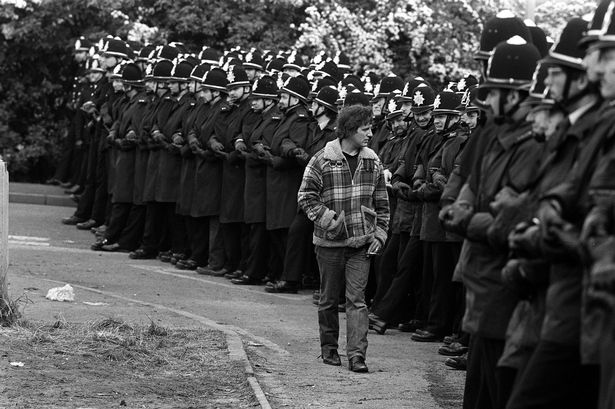
The primary function of the state in capitalist society is to maintain the capitalist system and aid the accumulation of capital.
As such, the state uses repressive laws and violence against the working class when we try to further our interests against capital. For example, bringing in anti-strike laws, or sending in police or soldiers to break up strikes and demonstrations.
The "ideal" type of state under capitalism at the present time is liberal democratic, however in order to continue capital accumulation at times different political systems are used by capital to do this. State capitalism in the USSR, and fascism in Italy and Germany are two such models, which were necessary for the authorities at the time in order to co-opt and crush powerful working-class movements. Movements which threatened the very continuation of capitalism.
When the excesses of bosses cause workers to fight back, alongside repression the state occasionally intervenes to make sure business as usual resumes without disruption. For this reason national and international laws protecting workers' rights and the environment exist. Generally the strength and enforcement of these laws ebbs and flows in relation to the balance of power between employers and employees in any given time and place. For example, in France where workers are more well-organised and militant, there is a maximum working week of 35 hours. In the UK, where workers are less militant the maximum is 48 hours, and in the US where workers are even less likely to strike there is no maximum at all.
History
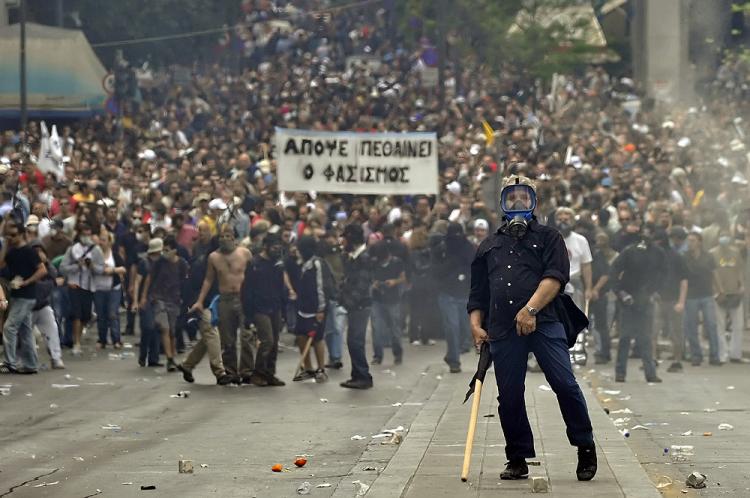
Capitalism is presented as a 'natural' system, formed a bit like mountains or land masses by forces beyond human control, that it is an economic system ultimately resulting from human nature. However it was not established by 'natural forces' but by intense and massive violence across the globe. First in the 'advanced' countries, enclosures drove self-sufficient peasants from communal land into the cities to work in factories. Any resistance was crushed. People who resisted the imposition of wage labour were subjected to vagabond laws and imprisonment, torture, deportation or execution.
Later capitalism was spread by invasion and conquest by Western colonial and imperialist powers around the globe. Whole civilisations were brutally destroyed with communities driven from their land into waged work. The only countries that avoided conquest were those - like Japan - which adopted capitalism on their own in order to compete with the other imperial powers. Everywhere capitalism developed, peasants and early workers resisted, but were eventually overcome by mass terror and violence.
Capitalism did not arise by a set of natural laws which stem from human nature: it was spread by the organised violence of the elite. The concept of private property of land and means of production might seem now like the natural state of things, however we should remember it is a man-made concept enforced by conquest. Similarly, the existence of a class of people with nothing to sell but their labour power is not something which has always been the case - common land shared by all was seized by force, and the dispossessed forced to work for a wage under the threat of starvation or even execution.
As capital expanded, it created a global working class consisting of the majority of the world's population whom it exploits but also depends on. As Karl Marx wrote: "What the bourgeoisie therefore produces, above all, are its own grave-diggers."
The future
Capitalism has only existed as the dominant economic system on the planet for a little over 200 years. Compared to the half a million years of human existence it is a momentary blip, and therefore it would be naive to assume that it will last for ever.
It is entirely reliant on us, the working class, and our labour which it must exploit, and so it will only survive as long as we let it.
More information
- The great money trick - Robert Tressel - a clever short introduction to how capitalism exploits workers from Tressel's famous novel The Ragged Trousered Philanthropists.
- Work Community Politics War - prole.info - an excellent introductory illustrated guide to capitalism and anti-capitalism.
- Capitalism and communism - Gilles Dauvé - a more detailed history and analysis of capitalism and its antithesis, communism.
- Capital - Karl Marx - Marx's definitive analysis and critique of capitalism. Heavy going but definitely worth giving a try at some point.
- Capitalism - further reading guide - libcom.org's guide to further reading on capitalist economics.
- Capitalism - libcom.org's capitalism tag
Files
Capitalism - an introduction.pdf
(47.37 KB)
Comments
One thing we would like suggestions on is if anyone can suggest a better picture for this article!
Clarify that "private ownership of the means of production," as used in the first paragraph, doesn't mean ownership by private individuals, but rather the ownership of the means of production by something other (and smaller) than society as a whole. As Bordiga wisely pointed out (and on which more can be found in Adam Buick's article on Bordiga, which is on Libcom) all property is private:
"Even from the point of view of terminology, property can only be conceived of as being private. For land this is more obvious in view of the fact that the flagrant aspect of this institution is a fence surrounding an estate which cannot be crossed without the consent of the owner. Private property means that the non-owner is deprived of the possibility of going into it. Whoever exercises this right, whether a private person or a group, the character of 'deprivation' remains for all the others."
And as we've seen, whether property is owned privately by individuals, by the state, or even by workers' cooperatives, capitalism still exists. Capitalism isn't a form of property ownership.
Another shortcoming is use of the word "corporation" in place of "capitalist enterprise." Complaining about corporations is leftist tripe; all profit-seeking enterprises are equally driven to exploit workers, ravage the environment, etc., regardless of whether they're big or small, corporations or whatever.
Other than that, this seems to be heading in the right direction.
i submitted this rather stupid image

if you ever do one for state capitalism, you should definitely use

or any other bit of money with Marx's face ironically minted onto it
To improve it somehow you need to get across the fact that it is a transitory system.
The impression is things will carry on until we somehow find the collective will to bring it down & that this collective will rests entirely upon changing peoples minds & spreading the word.
We know that, "it is not the consciousness of men that determines their existence, but their social existence that determines their consciousness".
So just as Rosa Luxemburg emphasized that capitalism would inevitably breakdown & Marx allude to it in part 3 of Volume III of Capital (the law of the tendential fall in the rate of profit), I think you need to get a few sentences in that make it clear that capitalism doesn't have a future.
Perhaps mention that capitalism must grow & that the planet is finite & that there's good evidence that supply-side barriers are being hit, e.g. peak-oil, putting downward pressure on the rate & profit & so attacks on working class conditions. Under such continuous attack workers will revolt.
Bosses call it profit, politicians economic growth.
This isn't right. What politicians call economic growth is growth in a measure of national income, such as GDP or GNP. Such measures are of the amount of spending done in a given period by all economic actors.
GDP = private consumption + gross investment + government spending + (exports − imports)
That doesn't necessarily have anything to do with profit. At the moment, bosses want more growth to get more profits, but this isn't always true: e.g. in the '70s (during a crisis of over-accumulation), growth needed to be brought down because it was posing a threat to profit.
At its root, capitalism is an economic system based on wage labour, money and the private ownership of the means of production
Well, wage labour is certainly vital. Money, of course, existed before capitalism - even before feudalism - as did private ownership of the means of production.
What distinguishes capitalism, apart from wage labour, is production for the purpose of (profitable) exchange. Capitalism emerges in proportion to the growth of universal commensurability of commodities (including labour), that is, insofar as they appear as valued according to a common standard in economic decisions such as personal consumption and investment.
The article describes the consequences of this quite well (in the section on competition), but doesn't articulate it explicitly as defining capitalism, as it does.
It can't be emphasised enough how far this sort of universal commensurability was not a feature of feudalism, slave owning society, and so on. The profit motive was present at least 5,000 years ago, but didn't come to dominate social, political, and productive decisions until capitalism - with the 1648 peace of Westphalia seen by G. Arrighi as the moment when this takes on political significance in the interstate system. The growing economic-political influence of the profit motive goes precisely in hand with the expansion of commensurability, of which is both a cause and product.
The means of production are all those things necessary for survival - factories, machinery, farms, offices, etc.
Machines are only "Necessary for survival" under water or in space. I agree that they are often useful. How about:
The means of production are things like factories, farms, machinery and offices.
Of course, if corporations were given a completely free hand to do as they please, monopolies would soon develop and stifle competition which would lead to the system grinding to a halt. The state intervenes, therefore to act on behalf of the long-term interests of capital as a whole.
Thats bang on. The collapse of Capitalism is not inevitible; it is overted by State interventions such as wars and bailouts. Revolutions can overthrow the State but unless an equal society is organised and defended, new inequities inevitably develop.
Public sector workers too face constant attacks on their wages and conditions in order to reduce costs and maximise profits.
I would consider deleting the bit in bold - the 'reduce costs' bit is obviously correct but there aren't any profits as such in the public sector, unless I'm missing something.
Armchair Anarchist
Public sector workers too face constant attacks on their wages and conditions in order to reduce costs and maximise profits.
I would consider deleting the bit in bold - the 'reduce costs' bit is obviously correct but there aren't any profits as such in the public sector, unless I'm missing something.
well in my sector (libraries), we charge massive amounts of money for fines, which is all deposited to a central office. local branches don't even get a look in. and i'm pretty sure some of it just goes straight back into the council's coffers as opposed to back into the library service.
also, private companies are involved in some contract deals, and money is often unfairly funnelled in their favour so they can make a profit.
Firstly, thanks very much for the feedback everyone, there are some very good comments here which we will try to incorporate. We definitely didn't think we would adequately cover a topic this big in our first draft.
Armchair Anarchist
Public sector workers too face constant attacks on their wages and conditions in order to reduce costs and maximise profits.
I would consider deleting the bit in bold - the 'reduce costs' bit is obviously correct but there aren't any profits as such in the public sector, unless I'm missing something.
what we actually meant it was profitability as a whole, as much of the public sector/welfare state is a cost to employers as a whole, so cutting costs can mean lower taxes on business and the rich and some more profits overall. So we will probably reword that.
Please keep the comments coming
Class: an introduction

An explanation of what we on libcom.org mean by the word "class", and related terms such as "working class" and "class struggle".
This article in: Bahasa Indonesia | Español | Français | Italiano | Türkçe | Nederlands
Introduction
The first thing to say is that there are various ways of referring to class. Often, when people talk about class, they talk in terms of cultural/sociological labels. For example, middle-class people like foreign films, working class people like football, upper-class people like top hats and so on.
Another way to talk about class, however, is based on classes' economic positions. We talk about class like this because we see it as essential for understanding how capitalist society works, and consequently how we can change it.
It is important to stress that our definition of class is not for classifying individuals or putting them in boxes, but in order to understand the forces which shape our world, why our bosses and politicians act the way they do, and how we can act to improve our conditions.
Class and capitalism
The economic system which dominates the world at present is called capitalism.
Capitalism is essentially a system based on the self-expansion of capital - commodities and money making more commodities and more money.
This doesn’t happen by magic, but by human labour. For the work we do, we're paid for only a fraction of what we produce. The difference between the value we produce and the amount we're paid in wages is the "surplus value" we've produced. This is kept by our boss as profit and either reinvested to make more money or used to buy swimming pools or fur coats or whatever.
In order for this to take place, a class of people must be created who don't own anything they can use to make money i.e. offices, factories, farmland or other means of production. This class must then sell their ability to work in order to purchase essential goods and services in order to survive. This class is the working class.
So at one end of the spectrum is this class, with nothing to sell but their ability to work. At the other, those who do own capital to hire workers to expand their capital. Individuals in society will fall at some point between these two poles, but what is important from a political point of view is not the positions of individuals but the social relationship between classes.
The working class
The working class then, or 'proletariat' as it is sometimes called, the class who is forced to work for wages, or claim benefits if we cannot find work or are too sick or elderly to work, to survive. We sell our time and energy to a boss for their benefit.
Our work is the basis of this society. And it is the fact that this society relies on the work we do, while at the same time always squeezing us to maximise profit, that makes it vulnerable.
Class struggle
When we are at work, our time and activity is not our own. We have to obey the alarm clock, the time card, the managers, the deadlines and the targets.
Work takes up the majority of our lives. We may see our managers more than we see our friends and partners. Even if we enjoy parts of our job we experience it as something alien to us, over which we have very little control. This is true whether we're talking about the nuts and bolts of the actual work itself or the amount of hours, breaks, time off etc.
Work being forced on us like this compels us to resist.
Employers and bosses want to get the maximum amount of work from us, from the longest hours, for the least pay. We, on the other hand, want to be able to enjoy our lives: we don't want to be over-worked, and we want shorter hours and more pay.
This antagonism is central to capitalism. Between these two sides is a push and pull: employers cut pay, increase hours, speed up the pace of work. But we attempt to resist: either covertly and individually by taking it easy, grabbing moments to take a break and chat to colleagues, calling in sick, leaving early. Or we can resist overtly and collectively with strikes, slow-downs, occupations etc.
This is class struggle. The conflict between those of us who have to work for a wage and our employers and governments, who are often referred to as the capitalist class, or 'bourgeoisie' in Marxist jargon.
By resisting the imposition of work, we say that our lives are more important than our boss's profits. This attacks the very nature of capitalism, where profit is the most important reason for doing anything, and points to the possibility of a world without classes and privately-owned means of production. We are the working class resisting our own existence. We are the working class struggling against work and class.
Beyond the workplace
Class struggle does not only take place in the workplace. Class conflict reveals itself in many aspects of life.
For example, affordable housing is something that concerns all working class people. However, affordable for us means unprofitable for them. In a capitalist economy, it often makes more sense to build luxury apartment blocks, even while tens of thousands are homeless, than to build housing which we can afford to live in. So struggles to defend social housing, or occupying empty properties to live in are part of the class struggle.
Similarly, healthcare provision can be a site of class conflict. Governments or companies attempt to reduce spending on healthcare by cutting budgets and introducing charges for services to shift the burden of costs onto the working class, whereas we want the best healthcare possible for as little cost as possible.
The "middle class"
While the economic interests of capitalists are directly opposed to those of workers, a minority of the working class will be better off than others, or have some level of power over others. When talking about history and social change it can be useful to refer to this part of the proletariat as a "middle class", despite the fact that it is not a distinct economic class, in order to understand the behaviour of different groups.
Class struggle can sometimes be derailed by allowing the creation or expansion of the middle class - Margaret Thatcher encouraged home ownership by cheaply selling off social housing in the UK during the big struggles of the 1980s, knowing that workers are less likely to strike if they have a mortgage, and allowing some workers to become better off on individual levels, rather than as a collective. And in South Africa the creation of a Black middle class helped derail workers' struggles when apartheid was overturned, by allowing limited social mobility and giving some Black workers a stake in the system.
Bosses try to find all sorts of ways to materially and psychologically divide the working class, including by salary differentials, professional status, race and by gender.
It should be pointed out again that we use these class definitions in order to understand social forces at work, and not to label individuals or determine how individuals will act in given situations.
Conclusion
Talking about class in a political sense is not about which accent you have but the basic conflict which defines capitalism – those of us who must work for a living vs. those who profit from the work that we do. By fighting for our own interests and needs against the dictates of capital and the market we lay the basis for a new type of society - a society based on the direct fulfilment of our needs: a libertarian communist society.
More information
- Work Community Politics War - prole.info - an excellent introductory illustrated guide to capitalism and anti-capitalism.
- Strata in the working class - Martin Glaberman - excellent article analysing divisions within the working class.
- The Working Class and Social Change - Martin Glaberman - another great article by Glaberman, this time on the meaning of class consciousness and working class action.
- Capitalism and communism - Gilles Dauvé - a detailed history and analysis of capitalism and its antithesis, communism, with interesting sections on the meaning of class.
Files
Class - an introduction.pdf
(96.08 KB)
Comments
Just to pre-empt some possible comments: we deliberately didn't go into race and gender here. We did start to go into it in one version, but the article just kept getting bigger and bigger, so we thought we would save it and have future articles on race and gender separately.
I think that the area on class struggle outside the workplace is quite weak, so if anyone can suggest improvements to that it would be much appreciated.
I liked this. I just had two areas where I though people without much exposure to these kind of ideas might not get what you were saying easily. The first was "We are the working class resisting our own existence. We are the working class struggling against work and class." Which is true, but is not as simple and straightforward in tone as the rest of the piece. Maybe there is a clearer way to say the working class struggles against class society as such.
The other thing was that the piece says that benefits claimants are working class, which I agree with, but doesn't explain why (structural unemployment; social safety net for sick or disabled workers being a class victory, etc.) and I think a lot of working class people would not automatically think that benefit claimants are working class so that point could be made a little more explicitly.
Finally, an example of middle classification of workers being used to derail class struggle might be thatcher's sell off of social housing. Using an example from closer to home might resonate more with workers in Britain.
But overall, as I say, I really liked it.
Thanks for this article. It is a good start at breaking down the concepts.
an example of middle classification of workers being used to derail class struggle might be thatcher's sell off of social housing. Using an example from closer to home might resonate more with workers in Britain.
I would certainly say the same for the US. I'm not sure which example would be an apt one to use. Many people 'understand' the middle class since it's on display in so many TV shows, movies, etc. The 'working class' doesn't get portrayed that way, and thus people don't identify with it.
It should be pointed out again that we use these definitions in order to understand social forces at work, and not to label individuals or determine how individuals will act in given situations.
Again, in the American context this is important because of the omnipresent mythology of meritocracy.
Thanks for the feedback. I'll wait to respond after we get some more comments
This is a good idea: introductory articles stating communist politics in a basic form. Which could be useful for pointing people toward who are new to politics and could help clarify a few simple things quite easily.
Am I right in thinking so that this is the first in a series of articles? - with ones on 'gender', 'race' and 'class struggle beyond the workplace' to follow.
Good stuff. We need to be better at explaining the basics.
Stakhanovite is probably a bit too jargony/specialist language for this article.
I think perhaps it should say something brief about the state, because by the definition given MPs would be middle class - they sell their labour power for a wage, but are better off and have somewhat more powerful than other workers. But in fact they are ruling class. I think the same goes for city traders, who objectively control, day to day, large amounts of capital. Obviously these groups are very small in number, but are quite often raised, in my experience, as counter examples when a definition of class like that used above is suggested.
Maybe something in section 'Working Class' that specifically rejects that your class is determined by the colour of your collar?
I find that the paragraph before last is inconsistent. You say:
It should be pointed out again that we use these definitions in order to understand social forces at work, and not to label individuals or determine how individuals will act in given situations.
and yet
We focus on the 'proletarian condition' as a better way to understand the working class: those who without their wages, benefits or pensions would not be able to support themselves
clearly contradicts that assertion.
Yeah, I see what you mean, it's a bit confusingly written.. I think what we mean here though is that the label 'middle class' is useful only when looking at social phenomena (like gentrification or the examples cited), not for saying 'who is the most working class/who will struggle and who won't'..
Maybe drop the bit about labeling individuals and add "(which would include much of the 'middle class' as well)" at the end?
Tojiah
I find that the paragraph before last is inconsistent. You say:
It should be pointed out again that we use these definitions in order to understand social forces at work, and not to label individuals or determine how individuals will act in given situations.
and yet
We focus on the 'proletarian condition' as a better way to understand the working class: those who without their wages, benefits or pensions would not be able to support themselves
clearly contradicts that assertion.
you are correct: this is the problem of group authoring!
grumpy cat
Maybe something in section 'Working Class' that specifically rejects that your class is determined by the colour of your collar?
yes, good idea, will try to do.
posi
Good stuff. We need to be better at explaining the basics.
Stakhanovite is probably a bit too jargony/specialist language for this article.
yeah, you may be right. We could mention Thatcher and social housing there instead, or maybe just add a hyperlink to an explanation of Stakhanovite. I did like having it in there as it basically also shows that we consider the USSR to be capitalist as well.
I think perhaps it should say something brief about the state, because by the definition given MPs would be middle class - they sell their labour power for a wage, but are better off and have somewhat more powerful than other workers. But in fact they are ruling class. I think the same goes for city traders, who objectively control, day to day, large amounts of capital. Obviously these groups are very small in number, but are quite often raised, in my experience, as counter examples when a definition of class like that used above is suggested.
again, the state is something we did mention in an earlier draft - but again this made the article start expanding rapidly. I think we should leave it to a future article on the state (or maybe we could mention in one quick sentence that the state is the executive body of the whole capitalist class). I definitely don't want to start talking specifically about MPs and city traders and what class we think they are because that pretty much goes against the thrust of our article.
Red Ed, thanks for the feedback, we will try to slip something in their about benefit claimants and pensioners (maybe something like unemployed workers, workers too sick to work, retired workers).
Thanks for the comments - please keep them coming!
Gets the thumbs up from me - clear, concise, jargon free. Nice one.
edit - although on re-reading definition of 'middle class' seems a bit woolly + agree with posi about 'Stakhanovite'
This is a good article for opening. I would like to add few points for this discussion. Historically Marxists divide capitalistic society to two main classes who one of them has capital and another only man power to sell to survive. It is true, but incomplete definition.
Historical experience tells us to look at class differently. For me, the starting point is production and everybody's relation to it. work cannot be standard to judge individual's position in the society because every body is working. for example a jail guard is working when detains victims of the capital. A soldier is working when kills innocent people in capitalistic wars.
If we look at the society is depth, we could see producers, consumers, and distributors. The whole society is consumed by surplus value of producers. You can be a public worker without producing anything. these workers at the final analysis are benefiting from producing workers although they are exploited by capital.
Class struggle has different levels. When we are trying to improve our daily lives, we are fighting within the system in its own frame. This kind of class struggle produce gradual defeats. At the same time, it helps the capital to expand more. In long term these kind of class struggles weakens workers position in a specific society and world.
We have fought in this frame from the beginning but we have strengthened the capital and our enemies. There was a parliament member in England in 19th century who said if one day China becomes an industrialized country, British workers will not be able to maintain their wages as we have today. As a ruling class member, he understood the nature of capitalism much better than those called themselves socialist and social democrats.
This was a short comment. I apologize for my English skills. Fortunately or unfortunately English is my fifth language. Hope, we could exchange some historical experiences collectively.
Majid
This piece is a better introduction to what the hell we mean by "class" than I've seen anywhere else. It deals really well with the "but what about THIS person?" thing that seems to always come up.
I'd add more examples to the "Class and Capitalism" section, as it introduces quite a few terms. The explanations are clear, but they come really quickly all in a row.
If you're doing a series of introductory articles, you could come back and edit in links/footnotes in the older ones to the newer ones.
Cheers for the feedback Dan - yeah that is the intention to add hyperlinks to other introductory articles. In the meantime we will put in hyperlinks to the best articles we have on the site currently
armchair, can you explain what you mean about the middle class section being woolly? Unfortunately that is not really feedback we can take on board to make improvements. Some texts are not "woolly" in that area, like class war's unfinished business, but they are completely wrong
Maybe a section on 'pro working class' organisations like trade unions and 'workers' parties and the bureaucrats that have a hand in running them.
When talking about history and social change it can be useful to refer to this group as a middle class in order to understand the behaviour of different groups. Class struggle can sometimes be derailed by allowing the creation or expansion of the middle class - Stakhanovite workers in the USSR received extra benefits in return for identifying with the Soviet government and working hard as individuals for example, and in South Africa the creation of a black middle class helped derail workers' struggles when apartheid was overturned. Bosses try to find ways to materially and psychologically divide the working class.
Might be worth expanding on the sociological development of the middle classes in advanced 'free market' economies (opposed to state capitalist ones) and the decisive role competitive educational establishments have in determining social position and status (both psychological and material).
Black rainbow, they are worthy topics but we are trying to keep this article short, and I don't believe those are essential
thought the bit about the middle class was really good (explains it as a richer section of the working class).
you might want to go for a few token sentences to pay tribute to value critique stuff.
ie. libertarian communists see that our main goal is to get rid of capitalisms poor way of treating every thing as commodities with price tags etc (including the planet, us and ideas).
capitalism's inevitable need for a working class is what provides humanity with our ticket to communism, and class struggle is the vehicle that will get us to a society that treats things according to their true value.
factoring in some bit about this makes the whole idea of class struggle far richer in my mind.
EDIT: i've just seen that you've written a bit about commodites :wall:
Steven.
Black rainbow, they are worthy topics but we are trying to keep this article short, and I don't believe those are essential
Surely that entirely depends on who your aiming this article at?
No, blackrainbow, I think your point about unions and workers' parties are fair enough but I also think those are topics which need their own introductions. Otherwise you end up with one REALLY long article.. will def get round to writing those too though..
This is a tough one really!!
A good start.
I thought perhaps it could be improved at the beginning by words along the lines of:
''.......is a system based on the need of capital (accumulated social labour) to continually expand and resulting in economic breakdown and hardship for workers when it doesn't.''
and that:
''This is achieved by the collective exploitation of workers throughout the world by the capitalist class on a world scale irrespective of nationality.''
The collective nature of class and exploitation is important to emphasise more and in line with the overall objective you have set yourself here.
Maybe somewhere a comment such as:
''The working class must struggle to assert it's needs against those of capital in all areas of life but this will remain a constant never ending struggle unless workers can abolish classes including their own class status permanently and create a truly human society.''
Not sure about these particular words but you perhaps get my drift.
Steven.
armchair, can you explain what you mean about the middle class section being woolly?
Yep fair point about not being useful feedback - meant that 'a minority of workers will be better off than others' could be confusing, as it mixes sociological and economic definitions of class - often a plumber will be earn more and so be better off than a teacher, but most people would consider plumbers to be working class and teachers middle class, even though both are working class...?
Bump, because this has now been updated taking into account people's suggestions, and is no longer a draft. We will be writing more introductory articles as soon as we get the time
Brilliant article, nice and easy to understand but yeah I think it should perhaps go into some more depth whilst maintaining the easy to understand.
I think the 'middle class' section is still very confusing.
Frankly it is a term with so many possible definitions as to make it's use problematic in this short introduction.
I would prefer to deal with the issue of power relationships as being 'within the working class' (and as necessary 'within the capitalist or ruling class') broadly defined as you have already done. It is an important issue which we have discussed elswhere before and will no doubt do so again.
If you want to use the term 'middle class' to descibe a whole section of capitalist society that has a level of power over the (rest of) the working class then that can be justified, but don't mix that up with the differences between high and low paid workers or those who rent and those who 'own with a mortgage'. I mean does anyone really think workers who bought council houses under the right to buy scheme became 'middle class' in any sense? (whatever the divisive nature of this particular government policy - under both Tories and Labour). At one time we used to say that the RTB's were marked out by the new doors and windows now they are marked out by the fact that they have the oldest roofs!
Also the issue raised by 'Majid00' could be addressed better by emphasising the collective nature of social production under capitalism that I suggested earlier.
I know it's tough trying to write these short pieces but one more effort may be worth it.
The assumptions and imaginative limits of all public discourse in the US are pretty much those of the "middle class." The term notoriously designates a psychological rather than an economic order. The fact that almost everyone claims to belong to this order testifies to the triumph of words over facts. Even homeless people here people claim to be middle class.
It seems to me that this is a result of decades of indoctrination by the mass media and advertising and certain other long existing cultural features of the US that are not at work in Europe.
During the 1960s the liberal political establishment acknowledged the existence of the working poor (President Johnson began a "war on poverty") and Michael Harrington's book The Other America was briefly a best seller. Today, the political discourse of the ruling elites in this country is strictly limited to what needs to be done for the "middle class." This fact complicates the whole question of class consciousness for those of us waging our struggle in the US.
Is that amazing graphic availiable bigger?
Not to label individuals
Class analysis does label individuals; I propose that those 4 words are removed.
No longer a draft
So has it become moribund?
The graphic is available in massive PDF format here:
http://libcom.org/library/capitalist-society-poster
we're not going to remove those four words because class "analysis" which purports to identify individuals just gets you stuck in stupid questions like "what if one of my parents was a teacher, but the other was a miner, what class am I?" type nonsense.
It is no longer a draft, it is a final version
The bosses heart is in his wallet
He uses the club over you so he can wear diamonds
By organising right we can give him a spade with which to earn an honest living
Does that "label individuals"?
The question you quote is about class background and not economic class.
Keen to turn this section and the previous one into a zine )it's really good and accessible). Here's a possible cover:

Ha ha, looks good! We plan to write more sections as soon as we can. One on direct action is currently in the works
http://libcom.org/library/capitalism-class-class-struggle-ex-dummies
I've finally got around to designing a downloadable, ready-to-print PDF of these introductions to capitalism, class, and class struggle.* Includes graphics (the prole pyramid is the centerfold). Hope that it may be of some use.
*a section on unwaged work has been added.
That's an amazing cover! Did you do it Jared? Props!
I did, thanks! Although it's based on the 'info for Dummies' series and the image in the background is not—think it's a free graphic online somewhere.
Hoping to do a full series, as people really like '101' style zines at tables, events etc.
State: an introduction

A brief introduction to what we at libcom.org mean when we refer to the state and how we think we should relate to it as workers.
This article in: Bahasa Indonesia | Español | Français | Italiano | Türkçe | Nederlands
States come in many shapes and sizes. Democracies and dictatorships, those that provide lots of social welfare, those that provide none at all, some that allow for a lot of individual freedom and others that don't.
But these categories are not set in stone. Democracies and dictatorships rise and fall, welfare systems are set up and taken apart while civil liberties can be expanded or eroded.
However, all states share key features, which essentially define them.
What is the state?
All states have the same basic functions in that they are an organisation of all the lawmaking and law enforcing institutions within a specific territory. And, most importantly, it is an organisation controlled and run by a small minority of people.
So sometimes, a state will consist of a parliament with elected politicians, a separate court system and a police force and military to enforce their decisions. At other times, all these functions are rolled into each other, like in military dictatorships for example.
But the ability within a given area to make political and legal decisions – and to enforce them, with violence if necessary – is the basic characteristic of all states. Crucially, the state claims a monopoly on the legitimate use of violence, within its territory and without. As such, the state is above the people it governs and all those within its territory are subject to it.
The state and capitalism
In a capitalist society, the success or failure of a state depends unsurprisingly on the success of capitalism within it.
Essentially, this means that within its territory profits are made so the economy can expand. The government can then take its share in taxation to fund its activities.
If businesses in a country are making healthy profits, investment will flow into profitable industries, companies will hire workers to turn their investment into more money. They and their workers will pay taxes on this money which keep the state running.
But if profits dip, investment will flow elsewhere to regions where profits will be higher. Companies will shut down, workers will be laid off, tax revenues will fall and local economies collapse.
So promoting profit and the growth of the economy is the key task of any state in capitalist society - including state capitalist economies which claim to be "socialist", like China or Cuba. Read our introduction to capitalism here.
The economy
As promoting the economy is a key task of the state, let's look at the fundamental building blocks of a healthy capitalist economy.
Workers
The primary need of a sound capitalist economy is the existence of a group of people able to work, to turn capitalists' money into more money: a working class. This requires the majority of the population to have been dispossessed from the land and means of survival, so that the only way they can survive is by selling their ability to work to those who can buy it.
This dispossession has taken place over the past few hundred years across the world. In the early days of capitalism, factory owners had a major problem in getting peasants, who could produce enough to live from the land, to go and work in the factories. To solve this, the state violently forced the peasants off common land, passed laws forbidding vagrancy and forced them to work in factories under threat of execution.
Today, this has already happened to the vast majority of people around the world. However, in some places in the so-called "developing" world, the state still plays this role of displacing people to open new markets for investors. Read our introduction to class here.
Property
A second fundamental requirement is the concept of private property. While many had to be dispossessed to create a working class, the ownership of land, buildings and factories by a small minority of the population could only be maintained by a body of organised violence - a state. This is rarely mentioned by capitalism's advocates today, however in its early days it was openly acknowledged. As the liberal political economist Adam Smith wrote:
Laws and government may be considered in this and indeed in every case as a combination of the rich to oppress the poor, and preserve to themselves the inequality of the goods which would otherwise be soon destroyed by the attacks of the poor, who if not hindered by the government would soon reduce the others to an equality with themselves by open violence.
This continues today, as laws deal primarily with protecting property rather than people. For example, it is not illegal for speculators to sit on food supplies, creating scarcity so prices go up while people starve to death, but it is illegal for starving people to steal food.
What does the state do?
Different states perform many different tasks, from providing free school meals to upholding religious orthodoxy. But as we mentioned above, the primary function of all states in a capitalist society is to protect and promote the economy and the making of profit.
However, as businesses are in constant competition with each other, they can only look after their own immediate financial interests – sometimes damaging the wider economy. As such, the state must sometimes step in to look after the long-term interests of the economy as a whole.
So states educate and train the future workforce of their country and build infrastructure (railways, public transport systems etc) to get us to work and transport goods easily. States sometimes protect national businesses from international competition by taxing their goods when they come into the country or expand their markets internationally through wars and diplomacy with other states. Other times they give tax breaks and subsidies to industries, or sometimes bail them out entirely if they are too important to fail.
These measures sometimes clash with the interests of individual businesses or industries. However, this doesn't change the fact that the state is acting in the interests of the economy as a whole. Indeed, it can be seen basically as a way to settle disputes among different capitalists about how to do it.
State welfare
Some states also provide many services which protect people from the worst effects of the economy. However, this has rarely, if ever, been the result of generosity from politicians but of pressure from below.
So for instance, after World War II, the UK saw the construction of the welfare state, providing healthcare, housing etc to those that needed it. However, this was because of fear amongst politicians that the end of the war would see the same revolutionary upheaval as after World War I with events like the Russian and German revolutions, the Biennio Rosso in Italy, the British army mutinies etc.
This fear was justified. Towards the end of the war, unrest amongst the working classes of the warring nations grew. Homeless returning soldiers took over empty houses while strikes and riots spread. Tory MP Quintin Hogg summed up the mood amongst politicians in 1943, saying “if we don't give them reforms, they will give us revolution.”
This does not mean reforms are 'counter-revolutionary'. It just means that the state is not the engine for reform; we, the working class – and more specifically, our struggles – are.
When our struggles get to a point where they cannot be ignored or repressed anymore, the state steps in to grant reforms. We then end up spending the next 100 years hearing people go on about what a 'great reformer' so-and-so was, even though it was our struggles which forced those reforms onto them.
When as a class we are organised and militant, social reforms are passed. But as militancy is repressed or fades away, our gains are chipped away at. Public services are cut and sold off bit-by-bit, welfare benefits are reduced, fees for services are introduced or increased and wages are cut.
As such, the amount of welfare and public service provision to the working class in a society basically marks the balance of power between bosses and workers. For example, the French working class has a higher level of organisation and militancy than the American working class. As a result, French workers also generally have better conditions at work, a shorter working week, earlier retirement and better social services (i.e. healthcare, education etc) -regardless of whether there is a right or left wing government in power.
A workers' state?
For decades, in addition to the struggle in workplaces and the streets, many workers have tried to improve their conditions through the state.
The precise methods have differed depending on location and historical context but primarily have taken two main forms: setting up or supporting political parties which run for election and are supposed to act in workers' interests, or more radically having the party seize political power and set up a workers' government through revolution. We will briefly examine two representative examples which demonstrate the futility of these tactics.
The Labour Party
The Labour Party in the UK was created by the trade unions in 1906. It soon adopted the stated aim of creating a socialist society.
However, faced with the realities of being in Parliament, and therefore the dependence on a healthy capitalist economy they quickly abandoned their principles and consistently supported anti-working class policies both in opposition and later in government .
From supporting the imperialist slaughter of World War I, to murdering workers abroad to maintain the British Empire, to slashing workers' wages to sending troops against striking dockers.
When the working class was on the offensive, Labour granted some reforms, as did the other parties. But, just like the other parties, when the working class retreated they eroded the reforms and attacked living standards. For example just a few years after the introduction of the free National Health Service Labour introduced prescription charges, then charges for glasses and false teeth.
As outlined, this was not because Labour Party members or officials were necessarily bad people but because at the end of the day they were politicians whose principle task was to keep the UK economy competitive in the global market.
The Bolsheviks
In Russia in 1917, when workers and peasants rose up and took over the factories and the land, the Bolsheviks argued for the setting up of a "revolutionary" workers' state. However, this state could not shake off its primary functions: as a violent defence of an elite, and attempting to develop and expand the economy to maintain itself.
The so-called "workers' state" turned against the working class: one-man management of factories was reinstated, strikes were outlawed and work became enforced at gunpoint. The state even liquidated those in its own quarters who disagreed with its new turn. Not long after the revolution, many of the original Bolsheviks had been executed by the government institutions they helped set up.
Against the state
This doesn't mean that our problems would be solved if the state disappeared tomorrow. It does mean, though, that the state is not detached from the basic conflict at the heart of capitalist society: that between employers and employees. Indeed, it is part of it and firmly on the side of employers.
Whenever workers have fought for improvements in our conditions, we have come into conflict not just with our bosses but also the state, who have used the police, the courts, the prisons and sometimes even the military to keep things as they were.
And where workers have attempted to use the state, or even take it over to further our interests, they have failed - because the very nature of the state is inherently opposed to the working class. They only succeeded in legitimising and strengthening the state which later turned against them.
It is our collective power and willingness to disrupt the economy that gives us the possibility of changing society. When we force the state to grant reforms we don't just win better conditions. Our actions point to a new society, based on a different set of principles. A society where our lives are more important than their 'economic growth'. A new type of society where there isn't a minority with wealth that need to be protected from those without; that is, a society where the state is unnecessary.
The state needs the economy to survive and so will always back those who control it. But the economy and the state are based on the work we do every day, and that gives us the power to disrupt them and eventually do away with them both.
More information
- Private property, exclusion and the state -Junge Linke - Brief article examining the role the state plays in capitalist society.
- The state: Its historical role - Peter Kropotkin - A classic anarchist text examining the state's role in society.
- The state in capitalist society - Ralph Miliband - Excellent book analysing the nature of the state and how it cannot be used in workers' interests.
- Capital and the state - Gilles Dauvé - More detailed libertarian communist analysis of the state.
- Marxism, freedom and the state - Mikhail Bakunin - A collection of writings of the Russian anarchist with comments on the state which were sadly proved accurate with the experiences of state socialist revolutions.
- The Bolsheviks and workers' control -Solidarity - A detailed examination of the anti-working class policies of the Bolsheviks in the earliest days of the Russian revolution.
- Labouring in vain -Subversion - A critical history of the Labour Party from a working-class perspective.
Comments
Please give us your thoughts and feedback on this article in the forums here:
http://libcom.org/forums/feedback-content/what-you-think-libcoms-introduction-state-27082012
Work: an introduction

libcom.org's brief introduction to work, what we think is wrong with it and what we, as workers, can do about it.
This article in: Français | Italiano | Türkçe | Nederlands
What is wrong with work?
For the majority of us, most of our lives are dominated by work. Even when we are not actually at work, we are travelling to or from work, worrying about work, trying to recover from work in order to get back to work the next day, or just trying to forget about work.
Or even worse, we don't have work and then our main worry is trying to find it. Or we are one of the people - mostly women - whose household and caring work does not count as paid work at all.
For many of us, we don't care about the work we do, we just need the money to get by. And at the end of the month, our bank balances are barely any different from the month before. We spend our days checking our watches, counting down the minutes til we can go home, the days til the weekend, the months til our next holiday…
Even for those of us who have jobs in areas we actually enjoy, we do not control our work. Our work controls us, we experience it as an alien force. Most of us do not control what time we get to work or what time we leave. Nor do we control the pace or volume of our work, what products we make or what services we provide, or how we do it.
For example, nurses may love caring for their patients but still be frustrated by bed shortages, insufficient staffing, punishing shift patterns and arbitrary management targets. And designers may enjoy being creative, but find their creativity is restrained: they are not given free rein to innovate in the way they may want, often having to effectively copy existing products which bosses know will sell.
Paradoxically, while millions of people are overworked, barely able to cope with high workloads and long working hours, millions of other people are jobless and desperate to work.
And then much work, which may be extremely difficult, boring and/or dangerous for workers and destructive for the environment, is not even socially useful. Like in manufacturing, where built-in obsolescence causes products to break down making people buy new ones, or entire industries like sales and advertising which exist only to persuade people to buy more products and work more to buy them.
Lots of other useful work is squandered in supporting socially useless industries, like energy generation being used to power telemarketing call centres, the manufacture of bogus cosmetic and medical products, or the arms industry whose only product is death.
While automation, mechanisation and productivity continually increases, working hours and working years don't fall. In fact, in most places they are rising, as retirement ages are put up and working hours are increased.
Why is work like this?
So if there are so many problems with work, why is it like this?
The reason is pretty simple: we live in a capitalist economy. Therefore it is this system which determines how work is organised.
As outlined in our introduction to capitalism, the primary essence of the capitalist economy is accumulation.
Money - capital - is invested to become more money. And this happens because of our work. Our work is the basis of the economy.
This is because our work adds value to the initial capital, and the value we add comes to more than our wages. This surplus value results in the growth of the initial capital, which funds profits and expansion.
The lower our wages, the harder we work and the longer our hours the bigger this surplus value is. Which is why employers in the private, public and even cooperative sector continually attempt to make us work harder and longer for less pay.
Similarly, our jobs are made dull and monotonous, so unskilled workers can do it cheaper. The products we produce or the services we provide are also often substandard to keep costs low.
Mass unemployment functions to keep wages of overworked employed workers down as workers who are not afraid of being replaced by the unemployed can demand higher wages, better conditions and shorter working hours. (This is why governments don't just end unemployment by reducing the length of the maximum working week.)
Enterprises which extract the most surplus value - and so profit and expand the most - succeed. Those which don't, fail.
So if a company or an industry is profitable, it grows. This is regardless of whether it is socially necessary, destroys the environment or kills its workers.
This growth also relies on unwaged work, such as housework or domestic labour. This includes the reproduction of workers in the form of producing and raising children - the next generation of workers - and servicing the current workforce: physically, emotionally, and sexually. This unpaid labour is predominantly carried out by women.
What can we do about it?
Even though the nature of work is determined overall by the economic system we live under, there are things we can - and do - do as workers here and now to improve our situation.
If our work is the basis of the economy, and the basis of growth and profits, then ultimately we possess the power to disrupt it, not to mention ultimately take it over for ourselves.
Every day we resist the imposition of work. Often in small, individualised and invisible ways. We sometimes get in late, leave early, steal moments to talk to colleagues and friends, take our time, pull sickies…
And sometimes we resist in bigger, collective and more confrontational ways.
By taking direct action like stopping work - striking - we stop the gears of production, and prevent profits from being made. In this way we can defend our conditions and leverage improvements from our bosses.
The working class together, including the unemployed and unpaid, can fight to improve other conditions, like for better state benefits or against high prices or regressive taxes.
In the 1800s in Western countries, working hours averaged 12-14 hours per day, six or seven days a week under appalling conditions with no holidays or pensions.
Facing off massive repression from employers and governments, workers organised themselves and struggled for decades, using strikes, occupations, go slows and even armed uprisings and attempted revolutions. And eventually won the far better conditions most of us have today: the weekend, paid holiday, shorter working hours…
Of course outside of the West many workers still experience these Victorian conditions today, and are currently fighting against them.
If we organise to assert our needs on the economy, we can improve our conditions further. And if we do not they will be eroded back to the level of the 1800s.
Conclusion
By organising together we do not only improve our lives now but we can lay the foundations for a new type of society.
A society where we don't just work for the sake of making profits we will never see or building a 'healthy' economy but to fulfil human needs. Where we organise ourselves collectively to produce necessary goods and services - as workers did albeit briefly in Russia in 1917, Italy in 1920, Spain 1936 and elsewhere. Where we get rid of unnecessary work and make all necessary tasks as easy, enjoyable and interesting as possible. A libertarian communist society.
More information
- Work - reading guide - libcom.org's reading guide about work, wage labour and the struggle against it.
- Workplace organising guide - libcom.org's guide to organising in your workplace.
- Workplace activity - libcom.org's archive of accounts of people organising in the workplace.
- Work and the free society - Anarchist Federation - A more detailed pamphlet from the AF analysing work in capitalist society, explaining its history and suggesting how work could be organised in a free society.
- Working: people talk about what they do all day and how they feel about what they do - Studs Terkel - Landmark work by Studs Terkel speaking to people working in a multitude of jobs and their feelings on them.
- Wages against housework - Silvia Federici - Autonomist Marxist feminist Silvia Federici on wages and housework.
- The right to be lazy - Paul Lafargue - In this text, Lafargue argues for the working class's right to be lazy, and says that productivity is the bosses' problem, not ours.
Comments
Please give us your thoughts on this article here:
http://libcom.org/forums/feedback-content/what-you-think-our-work-introduction-03022013
Unions: an introduction

A brief introduction to trade or labour unions, their function in society and how we at libcom.org think we should approach them, as workers.
This article in: Español | Français | Português | Türkçe | Nederlands
To most people, a union is an organisation of workers created to defend and improve its members' conditions with respect to things like pay, pensions and benefits.
This is partially accurate, but definitely far from the whole story.
It leaves out the other side of trade unionism: the backroom deals, the cuts in pay and conditions presented as a "victory", the strikes called off pending endless negotiations, the members told to break the strikes of other unions, the union activists disciplined by their own unions…
Time and again, union leaders - even left-wing ones - disappoint us. And just like with politicians, every time they do, there's always another one telling us it'll be better next time if we elect them.
The problem, however, is deeper than having chosen the wrong person for the top-spot.
Bureaucracy
Unions of any reasonable size have a paid staff, and are organised like a company. You have six-figure salary earning executives, appointed middle-managers enforcing decisions from the top and a career ladder into social-democratic political parties, think-tanks, government departments.
In the workplace unions are run day-to-day by workers who volunteer to be representatives, and often suffer personal costs in terms of victimisation for their troubles. However, union members and their lay reps in the workplace can also come into conflict with the union's paid bureaucracy.
This is because the rank and file have different interests to the people who work for and run the union. Union leaders have to put the needs of the union as a legal entity above those of the union as a group of workers fighting for their own interests. This is because their jobs and political positions are dependent on this legal entity continuing to exist. So supporting any action which could get the union in trouble - such as unofficial strike action - is just not on the cards for union leaders.
Even at regional and local level, full-timers don't share the interests of their members. This isn't to do with their ideas or intentions (lots of full-timers are ex-workplace militants who want to help workers organise beyond their own workplaces), it's about their material interests. A win for a worker is more money, longer breaks, better benefits. A win for a full-timer is a spot at the negotiating table with management, so that workers will continue to pay membership dues to the union.
Lay rep or shop steward posts - often taken by the most militant workers - can be complicated. Unlike full-timers, they still work on the shop floor and are paid like those they work with. If bosses cut pay, their pay is cut too. And as a workplace militant, they can be victimised by their bosses for their role.
However, they must also balance between shop floor interests and the union bureaucracy's interests. For example, a union rep may be furious that her union is recommending workers accept a pay cut, but she will still have to argue for workers not to leave the union. If they put workers' interests ahead of the bureaucracy's they can find themselves under attack not only from their bosses, but also their union.
History
Some problems have been with unions since they were first founded. However others are the result of changes in capitalist society since then. Originally, trade unions were illegal, and any organising effort was met with intense repression from employers and governments. Early union militants were often jailed, deported or even killed.
However, when workers kept striking and fighting despite the repression, and succeeded in greatly improving their conditions, employers and governments eventually realised it was in their interests to allow unions to be legally established, and give them a say in the management of the economy.
In this way open conflict between employers and workers could be minimised, and the actual say workers would have could be drastically limited by creating complex legal structures through which our official "representatives" would speak on our behalf. And similarly the way in which we can have our say could also be regulated within a legal framework overseen by the state.
This process has taken place in different ways in different countries and different stages in history, but the net result is similar. Across much of the West we can join unions freely but the actions we can take to defend ourselves from employers are limited by the web of industrial relations laws. Big barriers are placed in the way of taking effective strike action, in particular by banning any action which is not directly related to particular union members' terms and conditions and any kind of solidarity action. The unions have to enforce these anti-worker laws on their own members, as if they did not they would suffer financial penalties and asset seizure - and therefore cease to exist.
Furthermore, once unions accept the capitalist economy and their place in it, their institutional interests become bound to the national economy, since the performance of the national economy effects the unions' prospects for collective bargaining. They want healthy capitalism in their country to provide jobs so they can unionise and represent them. It's not uncommon therefore for trade unions to help hold down wages to help the national economy, as the British Trades Union Congress (TUC) did in the 1970s, or even assist their national governments in mobilising for war efforts, as unions did across Europe in World War I, or as the militant US United Auto Workers (UAW) did in World War II, signing a no strike pledge.
Selling peace in the workplace
One thing which many radical and left-wing union members often argue for is 'reclaiming the unions' or, sometimes, building new unions without bureaucrats at all. The thing is, unions don't function how they do because of bureaucrats; it's that bureaucrats are created by how unions function (or want to function) in the workplace.
The union's role is a tricky one: in the end, they have to sell themselves twice, to two groups of people with opposing interests (i.e. bosses and workers).
To sell themselves to us, they have to show that there are benefits to union membership. This sometimes means they can help us take action to force management to maintain or improve our conditions, especially if they are trying to gain recognition in a workplace for the first time.
Through getting us to join, they show management that they are the main representative of the workforce. But equally, they also have to show that they are responsible negotiating partners.
Management need to know that once an agreement is reached, the union can and will get their members back to work. Otherwise, why would management do any deals with a negotiating partner that can't honour the agreements it negotiates?
It is from this desire to be a recognised negotiating partner that unions end up acting against their own members. It shows them up in front of management as not being able to control their members. This is why in the UK in 2011 you get a Unite union negotiator calling a rank and file electricians' group “cancerous” just as in 1947 a miners' union official called for legal action against wildcat striking miners “even if there are 50,000 or 100,000 of them”. Similarly, at highpoints in the US union movement in the 1940s and 1970s, the UAW got its own members disciplined and fired for striking unofficially.
So when unions ‘sell us out’ it's not just them ‘not doing their job properly’. They might do one side (ours) badly, but they're doing the other side really well! After all, they need to be able to control our struggles in order to represent them. And this is why the efforts of the so-called "revolutionary left" over the past 100 years to "radicalise" the unions by electing the right officials and passing the right motions have ended up in a dead-end. Indeed, rather than radicalising the unions, the union structures have more often deradicalised the revolutionaries!
The only unions which have resisted this have been those that refused to take this representative role, like the historical IWW in the USA, the old FORA in Argentina and the modern day CNT in Spain. This refusal has cost them in reduced membership numbers, state repression, or both.
Most unions take the easier road, helping to ensure peace, at our expense, in the workplace. They kick our problems into the long grass of grievance procedures, casework forms and backroom negotiations. And employers love it. As a manager at a multinational in South Africa once said when asked why his company had recognised the workers' union: “Have you ever tried to negotiate with a football field full of militant angry workers?”
Fit for purpose?
Since the 1980s, we've seen huge attacks on workers' conditions and drastic changes to the job market. Casual, temporary and agency work have become increasingly common, with workers changing jobs regularly. In the West, many of the traditional industries of the trade union movement have closed down and been replaced by those historically less organised like retail, hospitality and the service sector.
This new reality undermines traditional trade unionism as building union branches with a stable membership becomes much more difficult. However, rather than trying to keep members by helping militants organise in the workplace, the solution for the unions has been in mergers (NALGO, NUPE and COHSE into Unison, TGWU and Amicus into Unite in the UK) and in offering supermarket discount cards and cheap insurance as perks of membership.
Equally, the international nature of the job market has further undermined the official unions. Workers can be employed in one country while working in another and companies themselves can move factories and offices to where labour is cheaper.
For instance, in 2011, Fiat workers in Italy were encouraged by their unions to accept worsened contracts under threat of having the work moved to Poland. Meanwhile, Polish workers themselves were struggling against Fiat. However, in neither country did the unions try to forge international links between workers.
Breaking the rules together
Whereas their representative function makes dealing with the trade union bureaucracy extremely slow and draining for militants in them, these changes to the job market have made them more or less irrelevant for many workers outside of them.
When industrial disputes come up, non-union workers feel they can't do much to support while even those striking may feel they are just going through the ritual of official strike action: management put forward a terrible offer, the union is 'outraged' and calls a one-day strike (maybe a few), negotiations restart and strikes are called off, management come back with a very slightly less terrible deal and union bosses declare victory and recommend it to their members.
However, it does not always have to work like this. The important thing – whether we are members of a union or not – is that we go beyond the limits set by the official unions and restrictive labour laws. Instead of voting for different representatives or passing motions in stale union branch meetings, we need to organise together with our coworkers, to break their rules and stick to our own:
- Workplace meetings need to be open to all workers, regardless of what job they do, which union they're in (if any) or what kind of contract they're on.
- We need to respect each others' picket lines. Too often workers go on strike only to see their colleagues in other unions go into work. This makes all of our strikes weaker and only by sticking together can we shut down our workplaces and beat our bosses. For instance Shell tanker drivers won above inflation pay increases in 2008 when drivers from other companies refused to cross their picket lines. In the same year NUT and Unison crossed each other's picket lines in education, and neither won significant concessions.
- We rely on direct action and collective strength to get what we want, whether covered by industrial relations law or not. In 2008, Brighton bin workers fought back against management bullying, winning after barely two days of wildcat action. Another wildcat later that year confirmed their willingness to strike, with or without official union backing. So in 2009 when management tried to cut their pay by up to £8000 (per year, per worker), they forced management to back down just two days into a week-long official strike.
- Strikes need to be spread. Often issues don't just affect one workplace but whole industries and even across industries. We need to make links between our workplaces so we can come out to support each other. In 2009, when oil company Total tried to sack 51 workers, everyone walked out in support. Total responded by sacking over 600 workers for taking unofficial action. However, strikes spread across the energy industry and in just over a fortnight everyone got their jobs back.
- Solidarity needs to be as international as our employers. Instead of blaming immigrants taking jobs or undercutting wages, or foreign workers when factories are moved overseas, we need to support migrant workers and workers in other countries struggling to improve their pay and conditions. This will not only benefit them directly but will also mean that employers will no longer be able to use them to undercut wages of native workers either.
These are not new ideas. These are things which workers – both in unions and out – have done throughout history and, in doing so, have often come into conflict not just with their bosses but also their union bureaucracy.
Conclusion
We often see unions as an organisational framework that gives us strength. And certainly, this is partially true. What we don't always acknowledge (or at least don't act upon) is that the strength a union gives us is actually just our own strength channelled through - and therefore limited by - the union structure.
It is only by acknowledging this and taking struggle into our own hands - by ignoring union divides and not crossing each others' picket lines, by not waiting for our union before taking action, by taking unsanctioned action such as occupations, go slows and sabotage - that we can actually use our strength and start to win.
More information
Comments
In the Sainsbury’s staff pay rise this year (2023), Usdaw (Union of shop, distribution and allied workers) the Guardian (newspaper) sang out the praises of Sainsbury’s as an employer, however both forgot to mention that new employees and colleagues with less than two years employment will now not be paid for their first three days of sickness.
Direct action: an introduction

Visteon workers occupying their factory in Enfield, North London.
libcom.org's brief introduction to direct action and why we advocate it, as opposed to other forms of political activity.
This article in: Español | Français | Italiano | Português | Türkçe | Nederlands
Many people today are worried about the direction that the world is heading in. Whether it's about their working conditions or unemployment, the environment, housing, war or any number of other problems, it's certain that millions (even billions?) of people at some point look for some form of political action to solve their problem.
Why direct action?
There are loads of different methods which people use to try and change the world, too many to mention here. Often, however, we think that we can look for help from various 'specialists' like politicians, union leaders, legal experts and the like.
In reality, this isn't the case. Politicians and union leaders have interests different from our own, like basically anyone earning six-figure salaries or even those bumbling around £80-90,000 a year. And trying to find protection behind the law can leave us equally at sea, as the laws that protect us today can simply be changed tomorrow - assuming they're even enforced in the first place!
At the same time, we sometimes decide that at least we can decide to not 'take part' in the worst parts of capitalism. We can choose not to buy from certain 'unethical' companies or even grow our own food.
However, the problem with this is that it makes resistance to capitalism an individual lifestyle choice, and one that not all people can make. For instance, 'fair trade' and organic products are often more expensive than food which is neither.
More seriously though, it makes social problems about individual companies or governments which behave 'badly' rather than a problem with society as a whole. And it still leaves us to face them alone, through our consumer choices. Business as usual continues, just for different businesses. Exploitation continues and there's no amount of fair trade cashew nuts that's gonna change that!
This is why we favour direct action: because it relies on our collective strength to stop 'business as usual' rather than our individual lifestyle choices or appeals to political and union leaders. And because at the end of the day, it means relying each other – the others who share our situation – rather than on so-called 'experts' who ultimately won't have to live with our problems.
What is direct action?
Put simply, direct action is when people take action to further their goals, without the interference of a third party. This means the rejection of lobbying politicians or appealing to our employers' generosity to improve our conditions. Ultimately, it's not even just that they don't care – it's that they profit from making our conditions worse. For more on this, read our introduction to class and class struggle.
So we take action ourselves to force improvements to our conditions. In doing so, we empower ourselves by taking control of and responsibility for our actions. So, fundamental to direct action is the idea that we can only depend on each other to achieve our goals
Direct action takes place at the point where we experience the sharp end of capitalism. Often this will mean where we work, as our bosses try to sack us or make us work harder, for less money. Or it can be where we live, as local politicians try to cut spending by getting rid of public services.
Direct action in the workplace
Direct action at work is basically any action that interferes with the bosses' ability to manage, forcing them to cave in to their staff's demands.
The best-known form of direct action at work is the strike, where workers walk off the job until they get what they want. However, strike action can sometimes be limited by union bureaucrats and anti-strike laws. That said, workers often successfully ignore these limits and hold unofficial, or 'wildcat', strikes which return a lot of the impact of strike action.
Though there are too many to mention here, some other direct action tactics used by workers are:
- occupations; where workers lock bosses out of a workplace, effectively striking but not letting the boss replace them with strike-breakers (also known as 'scabs').
- Go-slows; where workers work much slower than usual so as to ensure that less work is done (and so less profit made).
- Work-to-rules, another form of on-the-job action, where workers follow every little rule to the letter, again so as to slow down the pace of work.
There are many examples of these kinds of tactics being used successfully. In 1999, London Underground workers engaged in a 'piss strike' against not being allowed to go home once their work was finished. Instead of pissing by the tracks as usual, they would insist on being accompanied to a toilet by the safety supervisor, who had to bring the rest of the team with them (for safety). On their return, someone else would 'realise' they had to go as well, effectively stopping any work happening!
In Brighton in 2009, refuse workers held a successful wildcat strike over management bullying while the same year saw Visteon workers in London and Belfast occupy their factories against redundancies.
Direct action in the workplace has often been used for political ends as well. For instance, in 2008, South African dockers refused to unload arms that were to be taken to Zimbabwe.
However, it is possible for successful direct action to take place outside of the workplace as well, over a variety of issues.
Direct action in the community
The 2003 Iraq war saw huge demonstrations, including the biggest in British history in London on February 15th where over a million people got really wet marching to Hyde Park. This was unsurprisingly ignored by politicians, who didn't really care about how wet, cold or numerous we were. But direct action outside the workplace and in the community can be effective.
The most famous example in recent British history is the Poll Tax. When Margaret Thatcher attempted to bring in the unpopular tax in 1989, up to 17 million working class people across the country refused to pay it. Non-payment groups spread through communities all over the UK and people set up local anti-eviction networks to confront bailiffs. By 1990, Margaret Thatcher and the Poll Tax had both been beaten. She was also later filmed crying on telly.
Similar non-payment campaigns successfully beat increasing water charges (1993-1996) and bin taxes (2003-2004) in Ireland. In 2011, working people in Greece began the 'We Won't Pay' campaign against rising prices, with people refusing to pay motorway tolls, public transport tickets and some doctors even refusing to charge patients for their treatment.
Mainland Europe has also seen the spread of 'economic blockades'. Often used by students or workers where strike action has not been hugely effective, they involve participants blocking major roads or transport hubs. The idea is that by stopping people getting to work or slowing the transportation of goods and services, the protesters block the economy in much the same way as a strike would.
Hundreds of thousands of people have been involved in tactics like these, breaking out from government-approved (and ineffective) tactics such as lobbying and A-to-B marches.
Rejecting ‘powerlessness’
Direct action is a rejection of the idea that we are powerless to change our conditions. Improvements to our lives are not handed down from above. They must be (and have always been) fought for.
We are always told about how people fought for the vote. Rarely, however, is it mentioned how workers fought for the welfare state, for decent housing, health care, wages, decent working hours, safe working conditions and pensions.
But direct action is more than just an effective means for defending or improving conditions. It is also, as anarcho-syndicalist Rudolf Rocker said, the “school of socialism”, preparing us for the free society many of us strive to create.
Like former Liverpool manager Bill Shankley's approach to life and football, direct action involves collective effort, everyone working for each other and helping each other for a common end. By using direct action, even when we make mistakes, we learn from experience that we don't need to leave things to ‘experts’ or professional politicians. This course offers us nothing but betrayal and broken promises as well as that long-felt sense of powerlessness.
Direct action teaches us to control our own struggles. To build a culture of resistance that links with other workers in their struggles.
And as our confidence grows in the strength of our solidarity, so too does our confidence in our ability to change the world. And as this grows, the focus moves from controlling our own struggles to controlling our entire lives.
Based on/stolen from What is Direct Action? by Organise! Ireland.
More information
- Direct action - Emile Pouget - Classic Emile Pouget essay on direct action in working class struggle.
- Direct Action? Who Cares! - Article from April 2011 issue of the Industrial Worker that explains that direct action isn't solely used for its effect on 'bread and butter' issues.
- Anarcho-syndicalist methods - A text from the French CNT-AIT written in March 2006, covering direct action tactics and strategy.
- Libcom.org workplace organising guides - A set of tips and advice guides for organising in your workplace from getting started to making demands and taking action.
Files
Direct action - an introduction.pdf
(52.88 KB)
Comments
Where in wales are there protests .I live near cardiff .I know a few people who will be left to starve if they pay this awful bedroom tax.The worry the stress that this is causing people is outrageous very frightening and i think this government is boarding on natzi style politics .The poor are targets since tories came into power.I would say tories hate the poor with nothing but contempt for us.These 3 men cameron ,osborne and ian duncan smith will go down in history as evil men ,causing misery across britain whilst giving tax breaks the millionaires.Just pure evil,
Environment: an introduction

A summary and examination of the environmental crisis and its causes, and how we think the problems can be solved.
This article in: Italiano | Türkçe | Nederlands
The earth is facing an environmental crisis on a scale unprecedented in human history. This crisis is already responsible for high levels of human suffering and, if it continues, risks the extinction of human life on the planet.
Environmental problems
The most damaging environmental issues in the world today are:
- Air pollution: creates climate change, a general increase in temperatures that will severely disrupt weather patterns causing mass floods, droughts and disease killing millions. Air pollution also destroys the ozone layer (that filters out dangerous cancer-causing rays from the sun) and causes respiratory and other diseases amongst humans which kills over 6 million people per year, according to the World Health Organisation.
- Solid waste: sea and land environments are being poisoned by the dumping of dangerous industrial wastes (such as mercury and nuclear waste). Also, the use of non-biodegradable material in products and packaging have turned many parts of the world into large rubbish dumps, poisoning and injuring people.
- Soil erosion: the result of factors like the use of chemical fertilisers, pesticides etc. as well as inappropriate land use and cutting down trees. For these reasons, soil is eroded at a faster rate than it is being produced, contributing to rural poverty. Some scientists suggest that by 2030 there will be only 20% of the world's forests remaining, 10% of which will be in a degraded condition.
- Extinction: plants and animals are being made extinct at a faster rate than any time since the dinosaurs died out. This loss of species undermines the eco-sphere on which all life depends.
What’s behind the environmental crisis?
People often say that the reason that the world is in its current state is because there are too many people or because of modern technology.
However, many of the most environmentally destructive practices are not done by or for the benefit of most people and nor is it the case that most modern industrial technologies are inherently destructive.
The problem is not that there are too many people or that modern technology is inherently destructive. The problem is in society - and particularly industry - as it is run today. Specifically, it is the burning of fossil fuels like oil, coal and gas, releasing carbon dioxide (CO2) resulting in global warming that is catapulting the planet towards disaster. However, it doesn’t have to be this way.
Many dangerous technologies and substances can be replaced. Instead of burning fossil fuels, renewable sources of energy can be used, such as wind or solar power. Petrochemical based plastics (for things like plastic bags), which are not biodegradable, can be replaced by starch-based plastics (which safely disintegrate if left outside).
Living in an eco-friendly way does not necessarily mean that we have to accept a lower standard of living. The real blame for the environmental crisis isn't because ordinary people leave too many lights on or use the wrong type of soap. It is the wasteful system of production for profit that is unsustainable. The real blame for the environmental crisis must be laid at the door of capitalism, governments, and the society that these forces have created.
Capitalism
Capitalism is an enormously wasteful system of production, geared towards market competition and profit. For companies to survive this competition, they profits must be maximised. And to maximise profits, costs must be kept low. So just as paying workers is a cost that needs to be minimised, so is the cost of protecting the environment and disposing of waste safely. Read our introduction to Capitalism here.
Installing safety equipment and monitoring the use of dangerous materials costs money and cuts into potential profits. It is more profitable to shift these costs onto society in the form of pollution.
This is without mentioning all the things produced in a wasteful or inefficient way. Huge numbers of products are built to break in order to keep sales up ('built-in obsolescence'). Useless or inefficient goods are promoted and sold by means of high pressure advertising, often with the aid of government policy (such as private cars in place of large-scale public transport). Furthermore, this advertising pressures us to dispose of useful items which are no longer “cool” and purchase new ones.
Nor are all goods produced under capitalism actually consumed by ordinary people. Sometimes companies produce more of a given product than can be sold on the market, leading to a price collapse and recession. The bosses' solution is to destroy or stockpile the "extra" goods, rather than distribute them to those who need them. In 1991 there were 200 million tons of grain worldwide which were hoarded to preserve price levels. Three million tons could have eliminated famine in Africa that year – and now the situation is still no different, with nearly half of the world’s food is wasted each year.
The state
In a capitalist society, the success or failure of a state depends on the success of capitalism within it. Therefore promoting profit and growth of the economy is the key task of any state in capitalist society. Read our introduction to the state here.
The state will not willingly enforce strong environmental protection laws against companies because it does not want to cut into their profits (and its own tax revenue).
In addition, it is often feared that strong environmental laws will make countries 'unattractive for investment'. For instance, in 1992, big business in Holland were able to block a proposed tax on carbon pollution by threatening to relocate to other countries.
As such, the environment cannot be saved by means of the state, or by electing a 'Green Party'. Green parties, like all opposition parties, always talk radical in opposition but act like the rest in power. In Germany in 2001, the Green Party were part of the government and condemned protests against the transport of nuclear waste and were jointly responsible for the mobilisation 17,000 police against protesting residents.
In 2007, the Irish Green Party, who had supported the 'Shell to Sea' campaign against the extraction of natural gas off northwest Ireland, entered government. They soon changed their stance, with one senior Green politician overseeing the project while in office.
Class
At a general level, it is clear that the environmental crisis affects everybody, and threatens the survival of the human race as a whole.
However, even though the environmental crisis is a global threat, working class people are those most severely affected by it. We are the ones that have to do the dangerous jobs that cause environmental degradation and live in areas damaged by pollution, while those with money can afford to move elsewhere.
While in the long-term a global environmental crisis would affect everyone, not everyone shares an immediate interest in fighting it: the bosses and the state profit from the processes that harm the environment. Only the working class have a direct interest right now in defending the environment.
Mainstream debates of 'jobs' vs. 'environment' must be rejected. Firstly, because those working in environmentally destructive industries will often live in the same towns those industries destroy. So their health, and that of their friends and family, is at stake, both while at work and at home.
And secondly, because state and employer concern is completely false. When they can make profit they will play down the environmental aspect, saying it provides jobs. And when it stops being profitable or economically important, they'll close it down, saying how bad it is for the environment and tossing everyone out onto the street, as we have seen with the ILVA steelworks in Italy .
How can the problem be solved?
As capitalism is an inherently destructive system, ultimately the only real way to stop the environmental crisis is to create a new society based on human need rather than profit.
However, this does not mean nothing can be done in the meantime. The environmental crisis was generated by capitalism and so must be dealt with by challenging it. And as the state is part of this system, only mass grassroots action can be an effective method to do so.
To do this, environmentalism must relate to the day-to-day needs of our class. It's for this reason that we don't see much use in abstract environmentalism separate from the class struggle.
In the workplace
As the people who produce all wealth in society, workers are able, by action at the point of production, to wield a powerful weapon against the bosses.
Because a large proportion of environmental damage comes from industry and because the workers and our communities are the main victims of this pollution, workers' struggles for health and safety are often the first line of defence for the environment.
By monitoring environmental damage as a part of health and safety we link the struggle for better working conditions, our health (on and off the job) and the environment. We can expose industrial use of toxic substances, demand industry use recycled products where possible and find alternatives for environmentally harmful products.
With enough power in the workplace, workers can even enforce environmentalism in polluting industries. For instance, in the 1970s, Australian construction workers enforced 'green bans' where workers refused to work on environmentally harmful projects.
In the community
A lot of working class environmentalism takes place in the community, such as campaigns for better public transport which then reduce the reliance of individuals on private cars.
It can also come in the form of stopping environmentally destructive projects being built or developed. For instance, in the UK in the early 1990s, anti-roads protests took place across the country. Though many were lost the level of community support meant that in 1995, 300 roads planned to go through natural areas or people's communities were cancelled.
In 2012, residents in Shifang, Western China, forced the government to scrap their plans to build a massive copper alloy plant which many feared would lead to serious pollution and health problems. And in Italy today there are many examples of working class environmentalism, such as the No TAV movement, which is struggling against the construction of a high-speed rail link through the mountains of Piedmont, involving whole communities using direct action in their battle for survival.
Conclusion
Environmental destruction is destroying large parts of the planet, threatening the existence of all species, including our own. However, this is not the result of bad choices made by individuals, but of how society is organised.
Companies maximise profits when they do not have to worry about the environment, while governments encourage investment when they do not try to impose strict regulations.
As a result, it is up to the working class to defend the environment as we are the only people with an immediate interest in defending it. And while we can use direct action to fight environmental destruction, ultimately, we will have to use our collective strength to build a new world, not based on the relentless drive for profit but on fulfilling human needs; including that of a clean and healthy environment.
More information
- Ecology and class: where there's brass, there's muck - Anarchist Federation - Pamphlet looking at the ecological crisis facing us today, what is being done about it and setting out in detail a libertarian communist view on what an ecologically sustainable world would be like.
- Social Ecology versus Deep Ecology: A Challenge for the Ecology Movement - Murray Bookchin - Murray Bookchin's critique of 'mystical' deep ecologists and his contribution to the development of a pro-working class environmentalism.
- Climate change and capitalist growth - Joseph Kay - A look at whether capitalism is completely incapable at controlling climate change, and what a capitalist approach to saving the environment might be (as well as its effects).
- Nature, Neoliberalism and Sustainable Development: Between Charybdis and Scylla - Harry Cleaver - An autonomist Marxist take on the effects of capitalist development on the environment.
- The politics of anti-road struggle and the struggles of anti-road politics - the case of the No M11 link road campaign - Aufheben - Fantastic in-depth article on the UK anti-roads movement of the 1990s
- 1971-1974: Green bans by builders in Australia - A history of the massive campaign of industrial action by building workers which protected the environment and local communities by refusing to work on harmful construction projects.
Comments
Please give us your thoughts and feedback on this article in the forums here:
http://libcom.org/forums/feedback-content/what-do-you-think-our-introduction-environment-04062013
Libertarian communism: an introduction

Assembly at the worker-run Zanon factory in Argentina
A short introduction to what we at libcom.org refer to as communism or libertarian communism, what it is and why we think it is a good idea.
This article in: Español | Français | Português | Türkçe | Nederlands | 中文
Introduction
When we speak of communism we are talking about two things. Firstly as a way of organising society based on the principle of 'from each according to ability, to each according to need', and secondly as the real movement towards such a society in the world right now. Here we will address these, starting with the latter, the less well-known meaning.
The real movement
In our introduction to capitalism we describe the capitalist economy and point out how the needs of capital - for profit and accumulation - are opposed to our needs as working class people.
Employers try to cut wages, cut pensions, cut jobs, increase working hours, speed up work and damage the environment. And when we can, we resist because the conditions we live under in this economy push us into asserting our needs against capital.
So when we do this: when we cooperate, when we use direct action and solidarity to assert our needs, like when we organise strike action or work to rule against pay cuts or higher workloads, we begin to lay the foundations of a new type of society.
A society based on cooperation, solidarity and meeting human needs - a communist society.
Communism as a movement, therefore, is the ever-present trend of cooperation, mutual aid, direct action and resistance of the working class in capitalist society.
At times this trend has encompassed huge numbers of the working class, in huge waves of social unrest and workplace militancy, such as during the labour rebellions across the British Caribbean in the 1930s, the postwar strike waves in America, Japan and across Africa, the Italian Hot Autumn of 1969, the British Winter of Discontent in 1978, the 1987 Great Workers' Struggle in South Korea, the 2001 Argentinian uprising or the anti-austerity resistance in Greece since 2010.
Sometimes this social unrest has even resulted in the explosion of revolutionary events. For example in Haiti 1794, Paris 1871, Mexico 1910, Russia 1917, Italy 1919-1920, Ukraine 1921, Spain 1936, Hungary 1956, France 1968, Portugal 1974 and the 1994 Zapatista uprising. These are just some of the occasions when the working class has tried, though collective action, to reshape society in our own interests, rather than the bosses'.
To each according to need…
There is no shortage in the world of politicians or political groups claiming to have ready-made blueprints for creating a fairer society. However, communism is not something which can be decreed into being by political parties or individual politicians but must be created, through mass participation and experimentation, by workers ourselves.
It is therefore worth pointing out at this stage that 'communism' has nothing in common with the former USSR or present-day Cuba or North Korea. These are essentially capitalist societies with only one capitalist: the state. And it equally has nothing to do with China, whose ruling party calls itself 'communist' while overseeing one of the world's most successful capitalist nations.
However, in the various revolutionary events throughout history (some of which mentioned previously), working class people have experimented with different aspects of putting communism into practice. In doing so, they laid down principles for how a communist society could be organised as well as practical examples of what is possible when we act together in our class interests.
Without bosses
Instead of ownership or control of the means of production - land, factories, offices and so on - being in the hands of private individuals or the state, a communist society is based on the common ownership and control of those means. And instead of production for exchange and profit, communism means production to meet human needs, including the need for a safe environment.
Already today, it is us workers who produce everything and run all the services necessary for life. We lay the roads, build the homes, drive the trains, care for the sick, raise the children, make the food, design the products, make the clothes and teach the next generation.
And every worker knows that often the bosses hinder us more than they help.
Examples abound demonstrating that workers can effectively run workplaces themselves. And in fact can do so better than hierarchically organised workplaces.
One recent example are the factories taken over during the 2001 uprising in Argentina, when one-third of the country's industry was put under workers' control. And historically, there have been even bigger and more widespread examples.
For example during the Spanish civil war in 1936, the majority of industries in revolutionary Spain were taken over and run collectively by the workers. Where it was possible in some areas workers pushed closer to a communist society, abolishing money or distributing non-scarce goods for free.
Mechanics in revolutionary Spain 1936
In Seattle in 1919 during the general strike the city was taken over and run by the workers. In Russia in 1917, workers took over the factories, before the Bolsheviks returned the authority of the bosses.
Without wages
Communism also means a moneyless society where our activity - and its products - no longer take the form of things to be bought and sold.
The principal concern most people hold as to whether a communist society could is asking if humans really can produce enough for us to survive without the implicit threat of destitution, enforced by the wage system.
However, there is ample evidence demonstrating that we do not need the threat of destitution or starvation hanging over us in order to engage in productive activity.
For most of human history, we have not had money or wage labour, however necessary tasks still got done.
In hunter-gatherer societies, for example, which were overwhelmingly peaceful and egalitarian there was no distinction between work and play.
Even today, huge amounts of necessary work is done for free. In the UK, for example, despite working long hours people (mostly women) also carry out over three hours unpaid housework every day. On top of this, nearly 10% of people also carry out unpaid care work and 25% of adults in England carry out voluntary work at least once a month. Globally, the value of unpaid labour to the economy was an estimated $11 trillion a year in 2011.
Almost every useful type of work you can think of is also done by some people for free, not as "work" for wages, demonstrating that they are not strictly necessary. Growing food, looking after children, playing music, fixing cars, sweeping, talking to people about their problems, caring for the sick, computer programming, making clothes, designing products… the list is endless.
Studies show that money is not an effective motivator for good performance at complex tasks. People having the freedom and control to do what they want how they want, and having a constructive, socially useful reason for doing so is the best motivator.
Things like the free software movement, too, demonstrate how non-hierarchical, collective organisation for a socially useful goal can be superior to hierarchical organisation for profit and that people don't need wages to be motivated to produce.
And without the profit motive, any technological advancement which makes a work process more efficient, instead of just laying workers off and making those remaining work harder (like happens at present), we can all just work a little less and have more free time. See our introduction to work for more information.
Without a state
In our introduction to the state we define government as "an organisation controlled and run by a small minority of people… [with] the ability within a given area to make political and legal decisions - and to enforce them, with violence if necessary."
With no division between employers and workers, and rich and poor, there is no longer a need for a body of organised violence controlled by a small number of people, like the police, to protect the property of the rich and enforce poverty, wage labour and even starvation on everyone else. And with no need to accumulate capital or make profit there is no longer the need for armies to capture new markets and new resources.
Of course there will still be a need to protect the population from antisocial or violent individuals. But this can be done in a localised and democratic way, by a mandated, rotating and recallable body, rather than by an unaccountable police force whose brutality and even murders almost always go unpunished.
To make collective decisions, instead of "representative democracy" which governs most countries at present we propose direct democracy. True democracy is more than the right to elect a handful of (often rich) individuals to make political decisions for us for a few years, while other decisions are made unaccountably in corporate boardrooms led by the "tyranny of the market".
We can control our struggles ourselves, from our groups of workmates up through workplace and community assemblies and we can come together to coordinate across huge geographical areas using communications technology and workers' councils with mandated and recallable delegates.
And as we can organise our struggles, we can also eventually organise society ourselves, as the working class has done before at times. For instance, during the 1956 Hungarian uprising, workers' councils were set up to organise the running of society as workers demanded a socialism based on working class democracy. And more recently, since the uprising in 1994, the Chiapas region of Mexico has been run independently from the state through direct democracy with no leaders and where public servants' terms are limited to two weeks.
Zapatista rebels in Chiapas
Conclusion
Many people may think that communism sounds like a good idea but doubt it would work in practice. However first it is worth asking "does capitalism work?"
As billions live in dire poverty amidst unimaginable wealth, and we hurtle relentlessly towards environmental catastrophe we believe the answer is a resounding "no". And while no system will be perfect, we believe there is ample evidence that a communist society would function far better than our current capitalist one for the majority of people - even for the rich who often aren't happy despite their wealth.
A communist society won't be without problems. But it will resolve the major issues we face today, like widespread poverty and ecological devastation, freeing us to tackle much more interesting problems.
Instead of the need to work more, produce more and accumulate more, we can instead focus on how to work less, make what work we need to do more enjoyable, have more fun, more happiness and more joy.
Instead of measuring the success of a society by GDP, we can measure it by well-being and happiness. Instead of relating to each other as 'staff', 'customers', 'supervisors' or 'competitors', we can relate to each other as human beings.
Those of us reading and writing this may never live to see a fully libertarian communist society. But even so communism as the real movement - the everyday fight to assert our needs against those of capital - improves our lives in the here and now, and gives us a better chance of protecting living and working conditions, as well as the planet, for ourselves and future generations. Indeed, it is communism as the real movement - that is, the everyday struggles to defend and improve our conditions today - that lays the foundations for communism as a free and equal society.
What we call this movement has, in different times and places, been called 'anarchist communism', 'libertarian communism' or simply 'socialism' or 'communism'. What matters, however, is not the name or ideological label but its existence, not just as a future ideal but as the living embodiment of our needs, our desires and our spirit of resistance in our everyday lives. This spirit of resistance exists, and has always existed, in every society and under every regime where there is injustice and exploitation; so then, does the possibility for a world based on freedom and equality for all.
More information
- Capitalism and communism - Gilles Dauvé - a detailed explanation of communism as the emergence of real human community and the antithesis of capitalism.
- Work Community Politics War - prole.info - an excellent introductory illustrated guide to libertarian communism and capitalism.
- A world without money: communism -The friends of 4 million young workers - text discussing libertarian communism and in particular the necessity of communism being a moneyless system.
- Parecon or libertarian communism? - a debate between the libcom group and advocates of a "participatory society", which clearly explains the arguments in favour of an economic system based on "to each according to need".
- The soul of man (sic) under socialism - Oscar Wilde - the famous writer and poet’s key text outlining his personal vision for a libertarian communist society, and its implications for personal freedom and potential.
- Collectives in the Spanish revolution - Gaston Leval - book examining the constructive achievements of the Spanish revolution, in which large parts of the country were run by the working class.
- From mass strike to new society - Jeremy Brecher - excellent text looking at the transition from mass strikes to a libertarian communist society, in particular examining historical examples in Spain, Italy and Russia.
- The conquest of bread and Fields, factories and workshops - Peter Kropotkin - two classic texts by the Russian anarchist communist which, while now dated are still invaluable. The former is an examination of what needs to be done and how in a communist society, the second spells out how such a society could be organised.
Comments
Please let us know what you think about this article here in our forums, in particular if you can think of any way of improving it: http://libcom.org/forums/feedback-content/what-you-think-our-draft-introductory-guide-libertarian-communism-130520
Comments
When will the intros on…
When will the intros on nationalism, race and gender come out? Are the admins no longer working on these?